



Estrogen Receptor/ERR
Estrogen receptors are a group of proteins found inside cells. They are receptors that are activated by the hormone estrogen (17β-estradiol). Two classes of estrogen receptor exist: ER, which is a member of the nuclear hormone family of intracellular receptors, and GPER (GPR30), which is a member of the rhodopsin-like family of G protein-coupled receptors. The ER's helix 12 domain plays a crucial role in determining interactions with coactivators and corepressors and, therefore, the respective agonist or antagonist effect of the ligand. Different ligands may differ in their affinity for alpha and beta isoforms of the estrogen receptor: estradiol binds equally well to both receptors, estrone, and raloxifene bind preferentially to the alpha receptor, estriol, and genistein to the beta receptor. Estrogen and its receptors are essential for sexual development and reproductive function, but also play a role in other tissues such as bone. Estrogen receptors are also involved in pathological processes including breast cancer, endometrial cancer, and osteoporosis. Alternative promoter usage and alternative splicing result in dozens of transcript variants, but the full-length nature of many of these variants has not been determined.
Estrogen Receptor/ERR Isoform Specific Products
All Product Categories
-
Estrogen Receptor/ERR Inhibitors
(134)
View all products
-
Estrogen Receptor/ERR Agonists
(162)
View all products
-
Estrogen Receptor/ERR Antagonists
(107)
View all products
-
Estrogen Receptor/ERR Activators
(51)
View all products
-
Estrogen Receptor/ERR Modulators
(119)
View all products
-
Estrogen Receptor/ERR Chemicals
(2)
View all products
-
Estrogen Receptor/ERR Degraders
(73)
View all products
-
Estrogen Receptor/ERR Controls
(6)
View all products
-
Estrogen Receptor/ERR Ligands
(29)
View all products
-
Estrogen Receptor Proteins
(2)
View all products
-
ER-alpha Proteins
(1)
View all products
-
ER-beta Proteins
(1)
View all products
-
Estrogen Receptor/ERR Related Products (821)
Related Products (821)

-
Recombinant Proteins (2)
-
Antibodies (11)
-
Estrogen Receptor/ERR Isoform Comparison

-
PROTAC ERα Degrader-12
 0 ImagesCat. No.: HY-174453PROTAC ERα Degrader-12 is a VHL-recruiting ERα PROTAC degrader with a DC50 of 1.02 μM in MCF-7 cells. PROTAC ERα Degrader-12 binds to ERα and recruits the VHL E3 ligase to form a ternary complex, promoting proteasomal degradation of both wild-type and mutant ERα, thereby inhibiting ER-mediated transcriptional activity and breast cancer cell proliferation. PROTAC ERα Degrader-12 can be used in the research of ERα-positive breast cancer.
-
Estrogen receptor antagonist 8
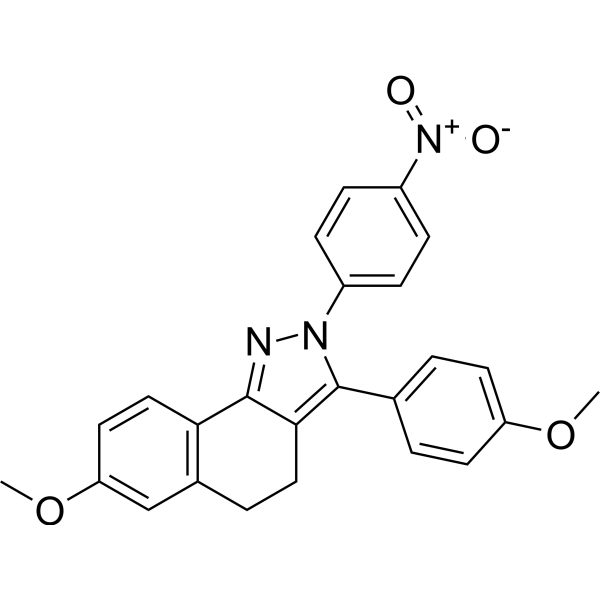 0 ImagesCat. No.: HY-143267CAS No.: 2889370-92-5Estrogen receptor antagonist 8 is a potent ER-antagonist with in vivo anti-uterotrophic potential (EC50 = 4.160 μM).
-
ER ligand-5
 0 ImagesCat. No.: HY-170339CAS No.: 2421262-07-7ER ligand-5 is the ligand for estrogen receptor, that can be used as ligand for target protein for PROTAC synthesis of PROTAC ERα Degrader-10 (HY-170336).
-
CS-1-69
 0 ImagesCat. No.: HY-128562CAS No.: 315702-79-5CS-1-69 is an MBD2 ligand analog that does not bind to individual NuRD components MBD2 or HDAC1, but binds robustly to the assembled NuRD complex (MBD2, HDAC1, and MT1A) in a dose-responsive manner. CS-1-69 attenuates Transcriptional Repression via Active Chemical Epigenetic Reprogrammin (TRACER)-mediated strogen receptor (ER) inhibitory activity.
-
Estrone sulfate-d4 TEA
 0 ImagesCat. No.: HY-113293S1Estrone sulfate-d4 TEA is the deuterium labeled Estrone sulfate TEA. Estrone sulfate is an inactive endogenous estrogen that can be converted into Estrone (HY-B0234) and Estradiol (HY-B0141). Estrone sulfate is also a substrate of the OATP1B3 transporter. Estrone sulfate can be converted into Estrone and Estradiol in normal mammary parenchymal cells. Estrone sulfate stimulates the growth of nitrosomethylurea-induced mammary tumors in ovariectomized rats and the colony formation of dispersed nitrosomethylurea mammary cells, with conversion into Estrone and Estradiol occurring both in vivo and in vitro during this process. Estrone sulfate is applicable to breast cancer-related research.
-
ERα antagonist 2
 0 ImagesCat. No.: HY-179232ERα antagonist 2 (Compound 5b) is an ER-α antagonist with an IC50 value of 1729 nM. ERα antagonist 2 exhibits significant inhibitory activity against breast cancer cell lines, and is still effective against ER-negative cells (MDA-MB-231), suggesting the existence of ER-independent pathways. ERα antagonist 2 can be used for the study of breast cancer.
-
Estradiol benzoate-d3
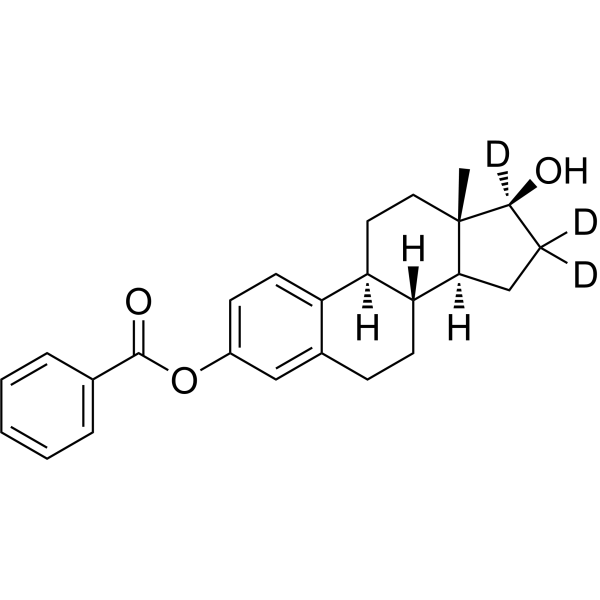 0 ImagesSynonyms: β-Estradiol 3-benzoate-d3; 17β-Estradiol 3-benzoate-d3Estradiol benzoate-d3 is the deuterium labeled Estradiol benzoate. Estradiol Benzoate (β-Estradiol 3-benzoate), a proagent of estradiol, acts as a steroid sex hormone. It exhibits mild anabolic and metabolic properties, and increases blood coagulability.
-
Propylparaben sodium (Standard)
 0 ImagesCat. No.: HY-N2026ARCAS No.: 35285-69-9Synonyms: Propyl parahydroxybenzoate sodium (Standard); Propyl 4-hydroxybenzoate sodium (Standard)Propylparaben (Propyl parahydroxybenzoate) sodium (Standard) is the analytical standard of Propylparaben sodium (HY-N2026A). Propylparaben (Propyl parahydroxybenzoate) sodium is an antibacterial preservative that can be produced by plants and bacteria. Propylparaben sodium is an orally active weak estrogen receptor agonist. Propylparaben sodium regulates the PI3K-AKT and JNK signaling pathways, and induces oxidative stress. Propylparaben sodium is commonly used in cosmetics, pharmaceuticals and foods, and can be used in studies related to ovarian aging and myocardial ischemia-reperfusion injury.
-
ER ligand-14
 0 ImagesCat. No.: HY-180851ER ligand-14 is an estrogen receptor (ER) ligand. ER ligand-14 can serve as a ligand for target protein for PROTAC, and can be used to develop and design degradative agents for PROTAC ERβ, such as ERB-2 (HY-180850). ERB-2 displays favorable antiproliferative activity against Osimertinib (HY-15772) resistance NSCLC cells.
-
α-Zearalenol-d4
 0 ImagesCat. No.: HY-N6710SCAS No.: 1778734-73-8α-Zearalenol-d4 is a deuterated labeled α-Zearalenol. α-Zearalenol is a Mycotoxin with high affinity for the estrogen receptors (ER), α-Zearalenol is the derivative of zearalenone (ZEN), causes reproductive disorders in animals, due to its xenoestrogenic effects.
-
(Z)-Norendoxifen
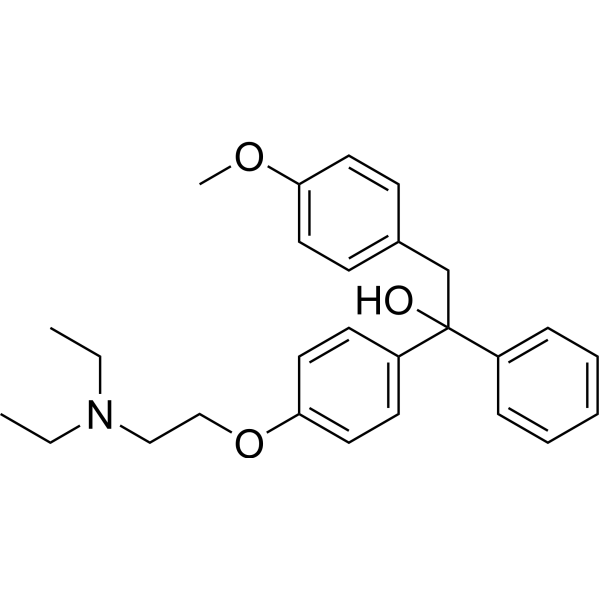
 0 ImagesCat. No.: HY-182498CAS No.: 1308808-22-1(Z)-Norendoxifen is an aromatase inhibitor and estrogen receptor modulator. The IC50 value of (Z)-Norendoxifen against aromatase is 102 nM. The EC50 values of (Z)-Norendoxifen for ER-α and ER-β are 27.0 nM and 35.2 nM, respectively. (Z)-Norendoxifen can be used in breast cancer research.
-
14-3-3σ/ERα stabilizer-1
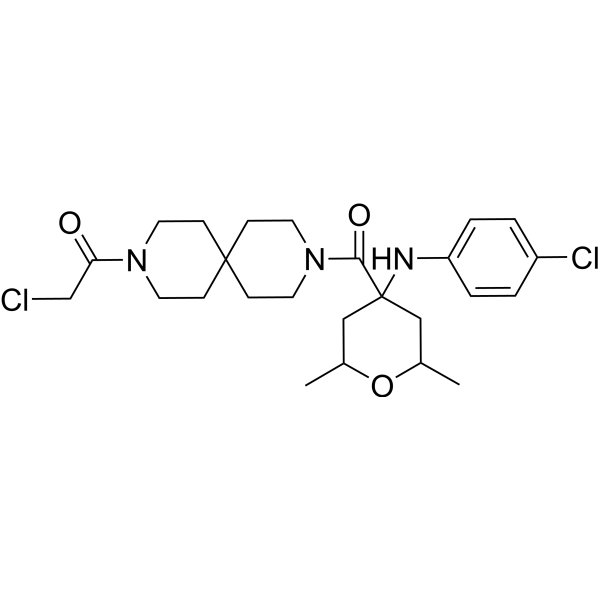 0 ImagesCat. No.: HY-15612514-3-3σ/ERα stabilizer-1 (Compound 181) is a covalent 14-3-3σ/ERα stabilizer. 14-3-3σ/ERα stabilizer-1 can be used for research of molecular glues.
-
SR-16157
 0 ImagesCat. No.: HY-123773CAS No.: 943344-76-1Synonyms: NSC 732011; HLX-801SR-16157 (NSC 732011; HLX-801) is a dual-action steroid sulfatase (STS) inhibitor (IC50 = 0.1 uM) and selective ERα modulator. SR-16157 exhibits STS inhibitory and anti-estrogenic effects in breast cancer cells. SR-16157 may be used in breast cancer research.
-
ERα ligand 6
 0 ImagesCat. No.: HY-187621ERα ligand 6 is an amino intermediate derived from OBHSA, and also serves as a precursor for the synthesis of ERα-targeted hydrophobic tag degraders, such as the ERα ligand moiety of ERα/RAD51 degrader 1 (HY-187096).

-
X15695
 0 ImagesX15695 is selective and orally active estrogen receptor (ERα) degrader. X15695 is an aryl hydrocarbon receptor (AHR) ligand. X15695 enables AHR to form a complex with the ERα, promoting its proteasomal degradation. X15695 inhibits the breast cancer cells proliferation, promotes cell cycle block and induces apoptosis. X15695 can be used for the study of breast cancer.
-
ER degrader 12
 0 ImagesCat. No.: HY-176955CAS No.: 2376991-14-7ER degrader 12 (Example 1) is an estrogen receptor (ER) degrader with IC50 values for ERα and ERβ of 2.3 and 80.2 nM respectively (TR-FRET experiment). ER degrader 12 inhibits the proliferation of MCF-7 cells, with an IC50 of 1.53 nM. ER degrader 12 can be used for research on breast cancer.
-
Chlorotrianisene-d9
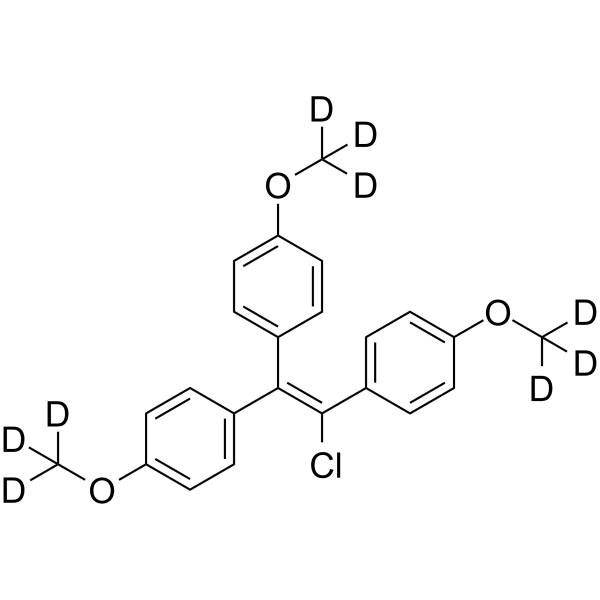 0 ImagesCat. No.: HY-B2158SCAS No.: 1276197-26-2Chlorotrianisene-d9 is the deuterium labeled Chlorotrianisene. Chlorotrianisene is a long-acting non-steroidal estrogen and an orally active estrogen receptor modulator. Chlorotrianisene exhibits antiestrogenic activity. Chlorotrianisene potently inhibits the enzyme COX-1 and inhibits platelet aggregation in whole blood.




